Atlas
Atlas is a decision-support web application for the University of Michigan community, giving students, instructors, and staff access to current and historical curriculum data. Over multiple years, I helped lead the product’s evolution from a more search-heavy experience into a more discoverable, task-oriented platform that better supported planning, exploration, and academic decision-making.
As lead designer, I worked across research, product strategy, interaction design, information architecture, visual design, prototyping, and front-end implementation support. I partnered closely with software developers, an application architect, stakeholders, and student fellows to move the product through continuous delivery cycles while balancing immediate user needs with longer-term system health.
The challenge:

Students needed better support for evaluating course options and building schedules, but the experience had to serve multiple audiences and accommodate a large amount of interconnected academic information. The work required more than visual refinement — it required clearer information architecture, stronger workflows, better discoverability, and scalable patterns that could support new features over time.
My role and scope:
Lead UX Designer across a multi-year product lifecycle
Partnered with engineering, architecture, stakeholders, and student contributors
Worked in continuous agile delivery cycles
Led research, facilitation, prototyping, front-end collaboration, and system-level experience design
What I led

Established a stronger product identity and design system foundation
Introduced personalized experiences for new and returning users
Reworked the information architecture to improve navigation and discoverability
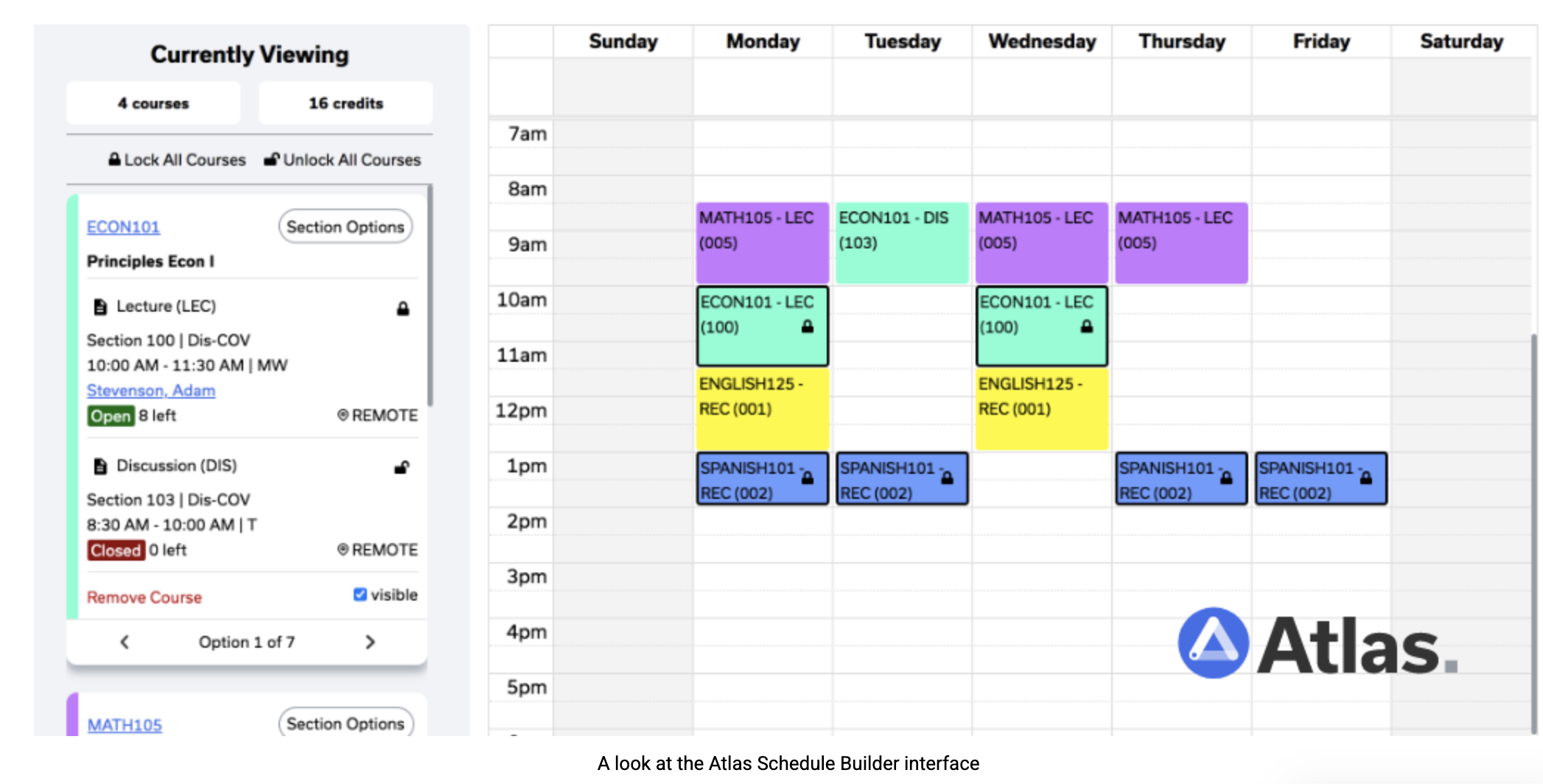
Led the design of a schedule builder from early concept through later iterations
Designed data visualizations that supported different audiences and decision-making contexts
Outcomes

The work contributed to clear growth in engagement over time. Atlas increased from 26,000 unique users in 2018 to 50,000 in 2021, while annual page views grew from 1.4 million to 6.2 million.
One of the highest-impact launches was the schedule builder, which drove more than 2 million interactions in the first few weeks after release.
